Showing posts with label Red-Headed Woman. Show all posts

Thursday, August 16, 2012

Pulp Fiction III: The British Connection

Kay was forever suffering the indignity of having her name misspelt (and no, I haven't misspelt "misspelt"; look it up) a fact pointed out by one New York gossip columnist who mentioned that Katharine Cornell also spelled (or should I say "spelt"?) her given name with two a's. (As did Katharine Hepburn, of course.) It must have been particularly galling, though, in the case of Avon's tawdry looking pulp edition of Red-Headed Woman. (The editors and art directors also managed to lose the hyphen in the title.)


What's really funny to me, though, is on the back of the book: a picture of the Bard being used to tout "GOOD BOOKS" by "Great Authors". That may well be the case, but it's completely incongruous with what's on the front cover. (Oh, remind me to show you my copy of The African Queen sometime!)


ANYway. One of the books in my collection is this 1948 British edition of Woman (depicting an elfin, modestly attired Lil--LOVE the Cinnabon hairdo!), inscribed by Kay in 1949 to some friends, with thanks for a lovely weekend. 


Now, one of the really nifty things about collecting is that sometimes you find little  unexpected surprises. Inside this copy of the book was this hand-written note from Kay ("Bob" was Kay's companion):


Isn't that cool? The "nasty-looking paperbound reprint, of the railroad station type" is undoubtedly the Avon edition. It's no surprise that Kay found it distasteful. The note also contains a bit of poignancy: Kay never would get around to writing that new book. She would be dead just three years later.

Friday, March 23, 2012

Renwood Tonight

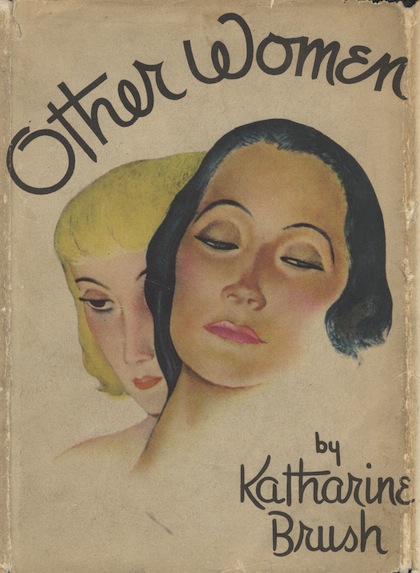
Other Women is ultra-rare with its
jacket:
 in my 5+ years of collecting,
this is the 
only one I have found.
In 1933 Farrar & Rinehart brought out Other Women, a collection of some of Kay's previously published short works. Half of the stories are set in Renwood, Ohio, already known to Kay’s readers as the home of Lillian Andrews. One story, in fact, centers around Louise Bartlett, the Renwood socialite who so ruthlessly and methodically cuts Lillian down to size during the course of a cocktail party in Lillian's own home. Published in 1930, the story very interestingly provides the first glimpse of Lillian, unnamed, mentioned only in passing. Here is Lillian in embryonic form, one which would later grow and develop fully into that notorious Red-Headed Woman. 


The fictional Renwood was based on the factual East Liverpool, Ohio, where Kay 
and her husband (and shortly thereafter their son Tommy) lived  from 1920 to 1926. Although Kay later maintained that she liked life in East Liverpool just fine, the pettiness, pretentions, and hypocrisies of Renwood’s ladies who lunch are archly chronicled by Kay, with little effort at concealing the contempt in which she must have held such narrow-minded provincialism. 


East Liverpool's country club is still there today; one of
Lillian Andrews's driving ambitions was to be afforded
entrée to the upper echelons of Renwood society, 

whose center was the country club.

Kay's handwriting was quite obviously 
the basis for the book jacket type.


Thursday, March 22, 2012

All the Pretty Red-Heads

Putting us on:
Dressler, circa 1931
As with the casting of Scarlett O’Hara years later, 
it would seem that virtually every female star in Hollywood was “considered” for the part of Lillian Andrews in MGM’s screen adaptation of Red-Headed Woman. Many of the names can certainly be dismissed as just so much hype (Garbo? Give me a break!); but so tireless and extensive were the efforts of MGM's publicity machine that no less than sexagenarian 
(with perhaps an emphasis on the "sex") comedienne extraordinaire Marie Dressler was prompted to throw her own hat in the ring!


What Bow's Lil Andrews
might have looked like
"It Girl" Clara Bow was reported by Time magazine as a natural, if not necessarily first choice. But this seems to be just another rumor, originating with Louella Parsons. Parsons claimed that MGM's Irving Thalberg sought her opinion regarding who should get the part. To that end, Parsons conducted a “poll” in her column, asking her readers who they wanted to see in the part; Bow, apparently, was America's overwhelming choice. But I can find no independent evidence (other than the Time piece) that Bow was ever seriously considered for, much less offered the rôle.


The only name that appears to have been seriously in the running is Joan Crawford, whose assumption of the rôle seems to have come close to becoming reality: The New York Times went so far as to announce Crawford as MGM's likely choice in October of 1931. But  according to at least one source I have seen, Crawford was given the thumbs down by Kay herself, though Kay makes no mention of any participation on her part in the casting of the picture in This Is On Me. (Interestingly enough, Crawford would play another Brush heroine five years later in Mannequin, but more on that in a future post...)


Joan Crawford almost looks as though she's posing as the artist's rendering of Lillian Andrews!


Carole Lombard, circa 1931
Other suggestions that at least look plausible on paper are Carole Lombard and Barbara Stanwyck.  

But by early May of 1932 the Times announced 
the final cast, shortly after declaring that

Miss Harlow has specialized on the screen in distasteful women and the fear of the average star 
that she will suffer from an unsympathetic part is 
just so much cream in Miss Harlow’s coffee.


What strikes me as funny is the fuss that was made at the time over Harlow’s 
hair-color—platinum blonde—which was hardly natural to begin with. One writer 
expressed dismay that the character would have to be turned into a blonde, and Parsons argued that the part should at least be given to a real red-head, conveniently ignoring the fact that Bow’s own red tresses came from a block of henna! And it’s odd that in the finished, black-and-white picture, Harlow’s hair (a wig, according to the Times) doesn’t even register as all that vivid. It makes me think of how Bette Davis’s “red” dress in Jezebel was actually not red at all…


I vant to be a red-head:
Garbo would eventually get her 
chance

to go "red," for 1939's Ninotchka


Wednesday, March 21, 2012

“So gentlemen prefer blondes, do they?”

The opening line of MGM’s topnotch treatment of Red-Headed Woman is an inside joke: 
the line, of course, is a reference to Anita Loos’ book Gentlemen Prefer Blondes, published in 1925. 
The joke is that Jean Harlow's blonde hair was already the star's trademark, and that the screenplay of Woman was written by none other than Loos herself—apparently after F. Scott Fitzgerald’s effort fizzled.


The accepted story, repeated by numerous Fitzgerald biographers, has it that the Fitzgerald script (produced with collaborator Marcel de Sano) was deemed too somber, and was tossed aside. In all fairness to Mr. Fitzgerald, it should be pointed out that Kay's original novel does not contain much—if any—of the humor to be found in MGM's realized adaptation. (By his own account, the experience left Fitzgerald more than a little disillusioned with Hollywood.) According to This is on Me, Loos was with the project from the beginning, and Fitzgerald a seemingly minor player. I'm not quite sure who to believe, but it would seem that Kay’s recollection in this instance is faulty. In any event, it’s Loos’ name in the opening credits, not Fitzgerald’s.

The picture premiered on June 25, 1932, and was an instant hit.

My favorite line in the movie? Lillian Andrews, trying on a dress in a shop (and standing in front of a sunny window), demurely asks the (off-camera) shopgirl 
“can you see through this?”  “I’m afraid you can, miss,” answers the shopgirl. 
“I’ll wear it,” comes Lil’s unexpected reply. It occurs within the first 2 minutes 
of the movie, and it lets us know right from the outset just what sort of picture 
this is going to be: 
    
“a quick, caustic biography of an alert, successful strumpet,” according to Time.


Jean Harlow (seated) and Anita Loos cutting up for MGM's publicity department

Tuesday, March 20, 2012

Young Woman with a Pulitzer

Here’s a suggestion for Christmas gift-giving from The Palm Beach Post’s “Book Nook”, December 20, 1931:


Probably too light in vein for a Pulitzer. Probably. Even that’s quite a compliment. As greatly as I admire Kay’s writing, as much as I enjoyed Red-Headed Woman, even I have to say that even “probably” was probably a bit optimistic.

The Outsider

I just finished reading Red-Headed Woman. I had left it for later, as I mentioned previously, because I felt I already knew the story well enough from the movie. 
In fact last night, with 20 or 30 pages left, I put the movie on, so that I could do a sort of side-by-side comparison. My initial assessment—that I knew it, the story—was only partially correct. The picture’s a good one, a lot of fun, but the book is, not surprisingly, much better, much fuller.

The jacket of the 
movie tie-in edition
The essentials are the same. Red-headed Lillian ("Lil") Andrews is from the "wrong side of the tracks." Lil works as a stenographer for the Legendres, who own a number of coal mines in Renwood, Ohio. Lil aspires to a more affluent, comfortable (well, pampered, really) life, and sets her sights on William ("Bill") Legendre, Jr. She uses her considerable feminine charms to seduce Bill away from his wife Irene. But even Renwood affluence isn’t enough for Lil, and, what’s worse, the social gates she thought would be flung wide to welcome her remain frustratingly, maddeningly barred. She decides it’s time to trade up, which she does by charming one C. G. Gaerste (rhymes with "thirsty"), whose wealth dwarfs that of the Legendres. ("You wouldn't call it money.")

Here’s where the stories diverge. In Kay’s original, Gaerste is, like Lil, an outsider of humble origins. Through hard work and sheer good luck he amassed his millions, which he now relishes in flaunting before all the world. Free of any “old money” snobbishness (to say nothing of restraint), he and Lil are simpatico. Gaerste sees Lil as simply another gorgeous, expensive ornament for him to dangle before envious, admiring eyes. Whether or not there’s any real affection between the two is completely beside the point.  

In the movie, Gaerste is a bit of an old coot, a wealthy friend and business associate of the Legendres. At first resistant to Lil’s wiles, Gaerste must be won over with sex.  And old coot or no, Gaerste is rich enough for Lillian to accept his proposal of marriage.
But then there’s a chauffeur (in the guise of Charles Boyer), a private investigator, a shooting, and an escape to Paris, none of which originated at the point of Kay’s pen. Oh well, both versions of the story end with Lil pretty much getting exactly what she wanted from the start.

Obviously, motion picture adaptations of literary works have to be condensed, streamlined. Characters get combined or added or eliminated altogether; events are truncated, shifted. At least this was the understood, the expected and accepted practice in 1932. Unfortunately, the central—it literally happens in the middle of the book—event in Kay’s original, the party scene, is shifted and condensed in such a manner and to such a degree that it loses most, if not all, of its impact.

The scene shows Kay at her best, I think, and can stand almost on its own as a story. It’s worth reading in its entirety, and if you’d like to do so, you can find it here. 

Here’s the emotional climax:

                She knew, she understood, then and thereafter. Her mind made swift and shattering translations. She could not delude herself, she could no longer, with the thin veil of Louise's subtlety, hide from herself Louise's meanings. Now she knew what all this was—deep in her mind she must have known it from the start, to know it so well now, to see it with such clarity. They were kidding her, these girls. Of course. Of course. They were giving her a ride. They were making fun of her, making a perfect fool of her—laughing at her behind the bright polite glaze of their eyes. They were collecting ludicrous quotations and descriptions, to take away with them; enough to last them for a long time. They were Irene's great friends, and this was sport and this was vengeance. So they had come. Now she knew well why they had come.

                This was what happened, then. This was what you got. You were the red-headed Andrews girl from Renwood Falls, from the railroad crossing, and you stole a rich husband and bought a big house, and a Chinese Buddha, and a naked dress, and you tried to crash Society—and this was what you got. Never mind what you expected, hoped for. This was what you got. This was what Society did to you, to make you understand. You couldn't crash it in a million years.

The scene as Kay’s written it also highlights one of the less tangible differences between novel and movie. Watching Harlow give life to Lil Andrews, we are alternately amused and scandalized (assuming we’re an audience of 1932, anyway) by her wanton brazenness. But we never feel sorry for her. Not once. And while we might cringe at the behavior, the taste and the choices of Kay’s “heroine,” she’s not one-sided; something akin to pity is often aroused in the reader. 

Pity for the outsider who so desperately wants to belong.

photo of Kay from the first edition dust jacket


Saturday, March 17, 2012

A Man And A Woman


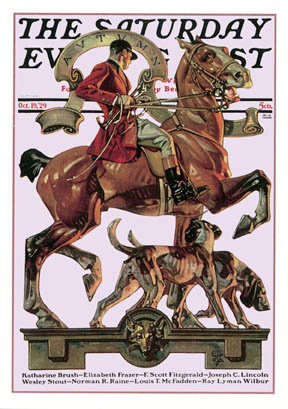
Kay's next—and most successful—
two novels began as magazine serials just like their two prede-
cessors. But their appearance in The Saturday Evening Post is surely evidence of Kay's increased literary stature.  


Young Man of Manhattan debuted in October 1929 (above left), and Red-Headed Woman in the summer of 1931 (above right). Publication in hard covers (below)  followed shortly thereafter.  


Above left: this later-printing jacket of Young Man of Manhattan boasts significantly higher sales (10 times higher!) than Kay's first novel, Glitter. Above right: the rare, first edition dust jacket of Red-Headed Woman depicts a pre-Harlow conception of Lil Andrews.


Left: Inscription inside one of my five copies of Young Man of Manhattan


"Swanie" is H. N. Swanson, Kay's long-time literary agent, whom she met during her days at College Humor. I have a number of Kay's books—all inscribed—that belonged to him.


Swanie was a pretty big deal. You can read what the Times said about him when he died in 1991.

Monday, March 12, 2012

Kay and Me

It started with a photograph.  I have in my collection a book, acquired years ago, titled The Decorative Twenties. In this book was--is--a photograph of a living room in a New York City apartment.  It was, in this young Long Island boy's eye and mind at least, the epitome of art deco style and elegance, and I thought, “someday  I will have an apartment in Manhattan with a living room like that.” And that was it; I never, over the course of several decades, paid any attention whatsoever to the who, what, where or when...


Flash forward twenty years, and I am working at an art and architecture non-profit (which shall forever remain nameless in these pages) in Manhattan.  

David Garrard Lowe, whose book Art Deco New York has recently been published, presents an illustrated lecture.  And, don't you know it... there's that photograph of that living room I know and love from my book!  So Mr. Lowe tells us that this is the living room in the Joseph Urban-designed apartment of the writer Katharine Brush.  


I confess that the name Joseph Urban didn't really mean anything to me at the time (more on him later), but I made note of the name Katharine Brush, and thought, “I wonder if her books are any good...they might be worth a look.”

I then discovered that Brush had written the novel upon which the movie Red-Headed Woman had been based.  I of course was familiar with the picture and had seen it.  It is, as I mentioned previously, a classic of pre-code Hollywood; I felt as though I already knew Katharine Brush...

Since I was so familiar with Red-Headed Woman, I figured it best to start with a different Brush novel, something that would be entirely new to me.  I decided on Young Man of Manhattan, from 1929.  Halfway through it I was hooked. 


Young Woman of Manhattan:
Katharine Brush
By the way, I did get the apartment in Manhattan...

but the living room looks nothing like I had planned.


Saturday, March 10, 2012

The Blonde Bombshell

Any spark of recognition mention of the name Katharine Brush might generate today certainly owes more to Jean Harlow's fame as an actress than to Katharine Brush's own fame as an author.

But an author she was, and a damn fine one at that.  Her wildly popular novel 
Red-Headed Woman was turned--almost instantaneously--into one of pre-code Hollywood's raciest, and most notorious pictures, one that helped catapult the 21-year-old Harlow to superstardom.


And while Katharine Brush outlived Harlow by fifteen years, the Blonde Bombshell's fame has proven far more durable, lasting far and long beyond the grave; Brush's, by contrast, was short-lived, and essentially died with her in 1952.
Jean Harlow with Chester Morris


Such, of course, is the nature of fame: writers seldom last as long as motion picture stars, and books generally do not attain classic status at the same rate as movies.


Though she later credited Harlow and her performance for making the picture the smash-hit that it was, Katharine Brush was, quite ironically, initially disappointed with MGM's choice of Harlow, who hadn't had that many big roles up to that time.  


And of course Harlow's hair was the wrong color...